
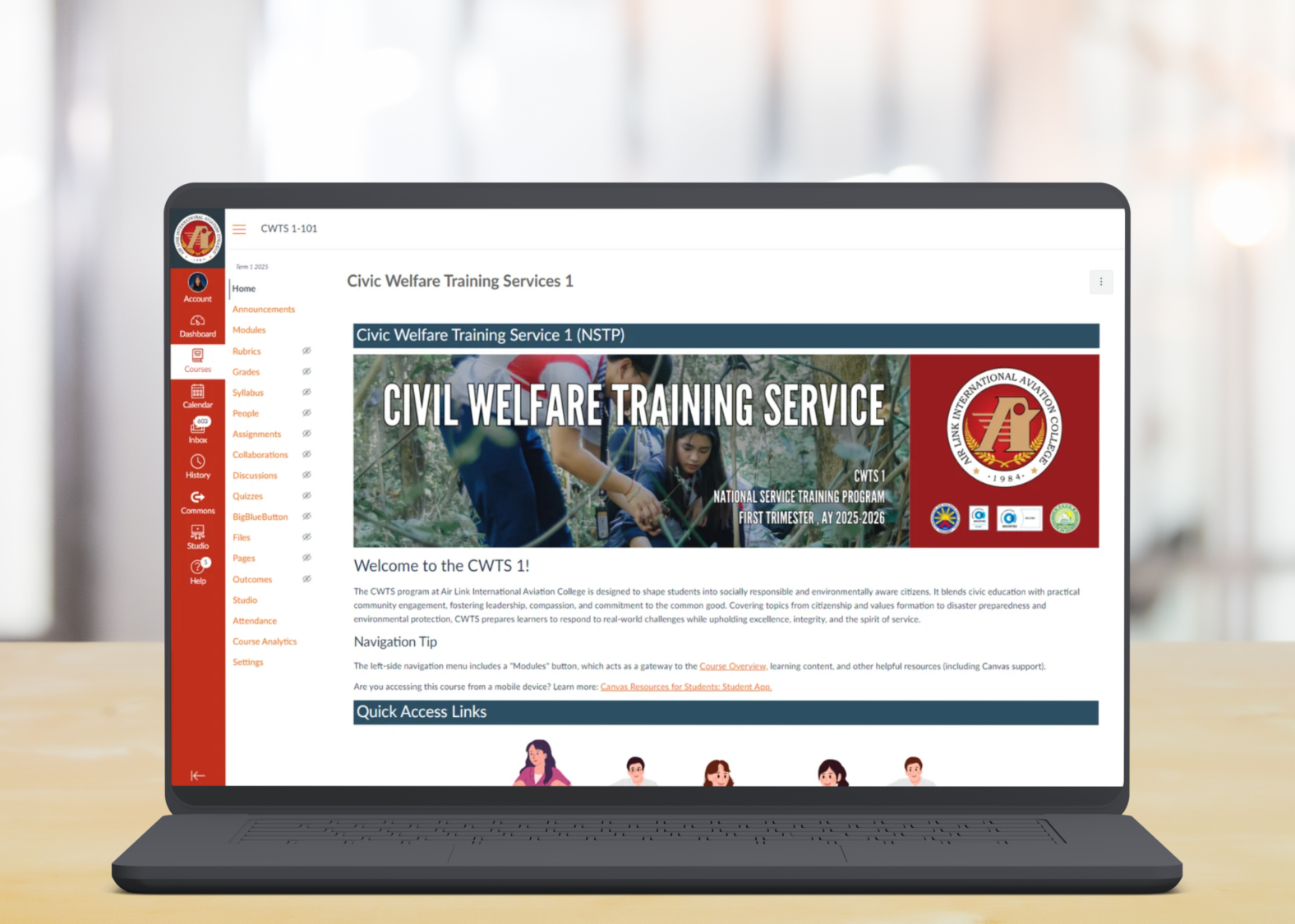
Civic Welfare Training Service 1 & 2 Course
I led the redesign of the Civic Welfare Training Service (CWTS) 1 and CWTS 2 courses under the National Service Training Program, transforming them from a traditional online format into a flipped learning modality using the ADDIE model. The goal was to create a more structured, engaging, and application-driven learning experience that would move beyond passive content delivery and instead empower students to work on real-life community and environmental issues. This initiative resulted in improved course organization, stronger learner engagement, and positive feedback from both administration and students, particularly in how the courses encouraged practical, community-based solutions.
In the Analysis phase, I reviewed the existing course structure, learner performance, and delivery challenges. I identified that the traditional format limited interaction and real-world application, which are critical in service-learning courses. I also gathered input from faculty and considered institutional goals, ensuring that the redesign would address gaps in engagement, clarity, and alignment with course outcomes. A key insight was the need to shift from content-heavy instruction to a model that prioritizes active participation and community immersion.
During the Design phase, I restructured both CWTS 1 and CWTS 2 into a flipped format, where foundational concepts were delivered through self-paced modules, and synchronous sessions were reserved for discussions, collaboration, and applied tasks. For CWTS 1, I organized content around civic education, national laws, disaster preparedness, and social awareness, integrating proposal development as a core output. For CWTS 2, I designed a scaffolded project-based framework that guided students through community needs assessment, data analysis, project planning, ethical engagement, and implementation. I ensured that all learning outcomes, activities, and assessments were aligned, with a strong emphasis on developing leadership, critical thinking, and teamwork skills.
In the Development phase, I created structured instructional materials, including self-paced lessons, guided activities, project templates, and assessment tools that supported both independent and collaborative learning. I designed materials that were clear, practical, and easy for faculty to facilitate, which contributed to consistent excellent evaluations from instructors who delivered the courses. The content was intentionally built to bridge theory and practice, enabling students to translate classroom learning into meaningful community initiatives, particularly those addressing environmental concerns.
For the Implementation phase, I supported the rollout of the redesigned courses and ensured that faculty members were equipped to deliver them effectively within the flipped model. A key component of implementation was organizing and facilitating two major field activities—a tree planting initiative and a coastal clean-up—which served as experiential learning opportunities aligned with course objectives. These activities were highly praised by participants for their organization and impact, reinforcing the value of hands-on, community-based engagement.
Finally, in the Evaluation phase, I gathered feedback from both students and faculty to assess the effectiveness of the redesign. The courses received strong positive responses, particularly in terms of clarity, relevance, and engagement. Faculty highlighted the ease of delivery and alignment of materials, while students demonstrated improved participation and the ability to develop and implement real-world solutions. Overall, the redesign successfully positioned CWTS 1 and CWTS 2 as dynamic, learner-centered courses that foster civic responsibility, environmental awareness, and active citizenship.